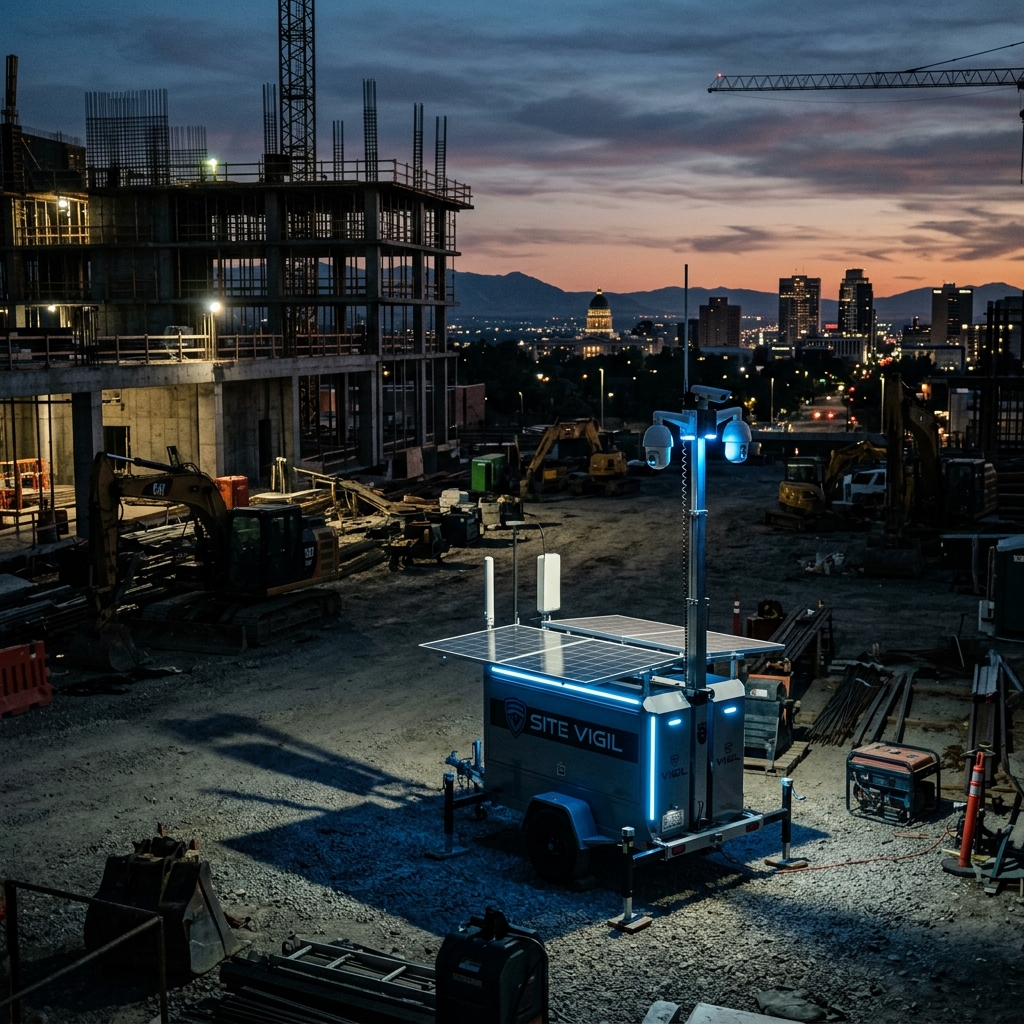
If you’re a contractor in Utah, you’ll know that horrible feeling when your crew arrives on a Monday morning to find that your copper wires, skid steer, or an entire tool trailer is missing. It’s not that uncommon. It’s estimated that construction theft costs the U.S. between $300 million and $1 billion annually, and that only 21% of the stolen equipment is recovered. Utah has its fair share, and St. George and Washington City recorded a string of thefts that cost site owners $400,000 in stolen equipment. For this reason, many contractors are now using solar-powered surveillance trailers in Salt Lake City and throughout the Wasatch Front to safeguard their job sites.
What Gets Stolen the Most?
Typically, thieves target items with the highest resale value. Some of the most frequent targets on construction sites in Utah are:
- Metals – Each year, U.S. job sites lose about $1 billion worth of copper. Wire spools and piping are very easy to steal and quickly sell.
- Power and Hand Tools – These are small and almost impossible to trace, making them perfect targets for thieves. The recovery rates for theft of these items are under 7%.
- Heavy Equipment – These include mini excavators and skid loaders, and are some of the most sought-after theft items in the U.S., with losses exceeding $30,000 on average.
- Lumber and Stolen Materials – The price for construction materials is high, and these items are quick and easy targets for thieves.
- Stolen Fuel – Thieves will even siphon diesel from construction vehicles.
When Theft Happens
Theft is a crime of opportunity, and thieves study schedules. Theft is most common when locations are empty for extended periods (60+ hours), such as after hours, weekends, or holidays. Statistically, most thefts in the U.S. occur in August since that is the busiest month in the construction season. Utah has a shorter construction season, which makes summer construction projects even more appealing to thieves. Theft is most common in laydown areas, staging areas, and along the perimeter where construction lights and power do not reach. This is the ideal opportunity for solar-powered security surveillance to fill that gap for Salt Lake City construction projects.
How Surveillance Stops It
Fencing a work site can slow a thief, but adding surveillance can change the situation altogether. Since the majority of construction job sites in Utah don’t have grid power during the initial building stages, solar-powered surveillance trailers eliminate the security gap and don’t require the added labor of trenching, generator setup, or electrical work.
The most common and most effective options for construction sites are:
Active deterrence. Security surveillance trailers communicate to intruders that they will be controlled and monitored on-site with visible camera masts, glowing lights, and audio messages.
Real-time surveillance. The modern solar-powered surveillance trailers deployed to Salt Lake City construction job sites use artificial intelligence (AI) for video motion detection and provide real-time theft monitoring and support. The surveillance support can view the theft in real time, determine that it is a theft, and document it to provide a prompt police escort.
Documented theft that is supportable. The surveillance trailers provide high-definition theft documentation that supports the apprehension of the thief and enhances the likelihood of securing payment for the job site and restitution for the documented theft.
Complete flexibility. Solar-powered surveillance trailers can be moved as your project advances. These trailers, positioned in Salt Lake City, can be moved this month to monitor the laydown yard and next month to cover the finished units.
The Bottom Line
Theft increases project costs by 1-5% due to additional expenses, reduced efficiency from delays, and increased insurance costs. For builders in Utah, the cost to place solar-powered surveillance trailers in Salt Lake City is much lower than the cost of theft, and they work every night, all winter, with no power needed, unlike padlocks. Protect the site before the first load of copper arrives, not after it disappears.